
Welcome to the European Radon Day 2026!
The topic for this year is “Radon and the future of healthy buildings“.
European Radon Day Activities
Austria
- Press release: 20th anniversary of the Austrian national radon centre: 20 Jahre Radonschutz: Gemeinsam gegen die unsichtbare Gefahr
- Article on AGES-webiste: 20 Jahre Radonschutz: Gemeinsam gegen die unsichtbare Gefahr – AGES
- Dedicated graph in the framework of the European Radon day topic “Radon and Healthy Buildings”: Grafik_Europäischer_Radontag_
07.11.2026.pdf - Dedicated article and slider on website radon.gv.at: 07.11.2026: Europäischer Radontag – Fachstelle für Radon
- Social-Media-Posts:
-
- LinkedIn: https://lnkd.in/p/dkhwq_QT; https://de.linkedin.com/posts/
austrian-agency-for-health- and-food-safety_7-november- heute-ist-europ%C3%A4ischer- radontag-activity- 7524757592397463552-bVS5 - Facebook: https://www.facebook.com/
share/p/1dP2uxDz5U/ - Instagram: https://www.instagram.com/
ages_news/p/DfcIaDYCkI9/
- LinkedIn: https://lnkd.in/p/dkhwq_QT; https://de.linkedin.com/posts/
Belgium
Note on FANC website: 7 novembre : Journée européenne du radon – Le radon et l’avenir des bâtiments sains | AFCN – Agence fédérale de Contrôle nucléaire
France
- CARSAT in France is in charge of Pension and Work Health Insurance Fund
The « CARSAT Bretagne » organised a webinaire the 3rd of November « Workplaces: designing at early stage of conception »
https://www.youtube.com/watch?v=tQUgvhdAl2A
The second link refers to the general website of CARSAT Bretagne for radon information
- ASNR organised a contest to win 30 passive radon detectors, featuring an awareness-raising presentation
Ireland
Links to the social media posts:
https://www.linkedin.com/feed/update/urn:li:activity:7524802992869576704
Italy
Today, November 7th, marks European Radon Day and it is the perfect opportunity to bring clarity to a crucial topic for indoor health that remains surrounded by widespread misinformation. Radon is a naturally occurring radioactive gas: colorless, odorless, and tasteless. It gives no warning signs and shows no immediate symptoms like headaches, yet it represents the second leading cause of lung cancer after smoking. You cannot guess its presence! The only scientifically valid way to know if Radon is an issue is to MEASURE IT.
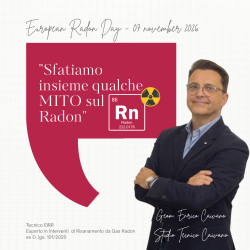
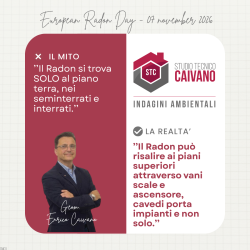
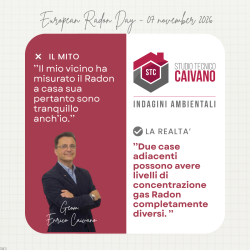
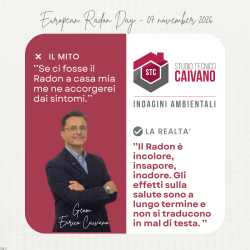
Swipe through photos to debunk 4 of the most common myths together:
1. “It is only found in basements” – False, it easily migrates to upper floors.
2. “If my neighbor’s house is fine, so is mine” – False, levels can vary dramatically between adjacent buildings.
3. “I would notice symptoms if it were present” – False, it has no scent or taste and acts over the long term.
4. “It only affects smokers” – False, it poses a health risk to anyone breathing indoor air.
Whether it is your home, a study space, or your workplace, protecting your health starts with real data.
Take control of your indoor safety: schedule a measurement or reach out to certified experts who know Radon inside out to assess the risk in your property.
Spain
The radio program “A hombros de Gigantes” produced by RNE (Spanish public radio service) dedicated 7 min of the podcast broadcasted on 7th of November to radon. Get access to the podcast using the URL https://rneaudio.rtve.es/a/17301351
Switzerland
ORTQAI (Observatoire romand et tessinois de la qualité de l’air intérieur) organized a webinar on radon the 5.11.2027 with the theme: Radon and Construction—What If Health Depended on the Design Phase?
Invisible, odorless, but far from harmless, radon is a major public health issue that is too often overlooked in construction and renovation projects. Yet in Switzerland, it is the only indoor air pollutant regulated by the Federal Radiation Protection Ordinance. So why is it still so difficult to integrate it into the practices of construction professionals? Understanding the health risks, identifying high-risk situations, and learning about the tools available and construction solutions… This webinar aimed to move beyond common misconceptions so that radon is properly considered in building quality, from the design stage right through to the end of the building’s life cycle.